I found a great (but short) video of the Rhodes Mark 7 at NAMM:
http://www.gearwire.com/media/rhodes-piano-wnamm-1.mov
Also, if you are interested, there are great conversations regarding the Rhodes Mark 7 on The Super Site Forums:
I found a great (but short) video of the Rhodes Mark 7 at NAMM:
http://www.gearwire.com/media/rhodes-piano-wnamm-1.mov
Also, if you are interested, there are great conversations regarding the Rhodes Mark 7 on The Super Site Forums:
As I find new pictures on the web, I’ll make sure to link to them here:


Found some more photos on the web of the Rhodes Mark 7. Shows the pitch bend and mod wheels, speaker cabinet, and (of interest to me) the 61 key passive electronics model (the one in red).
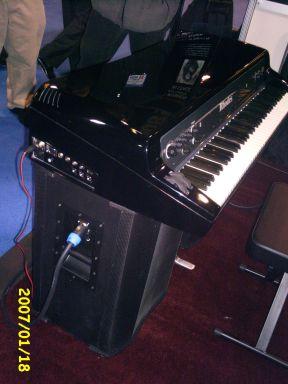
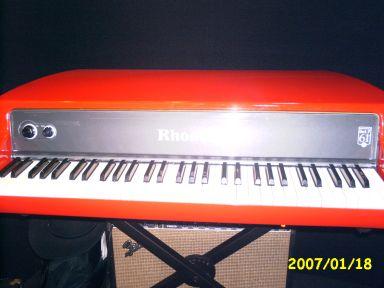
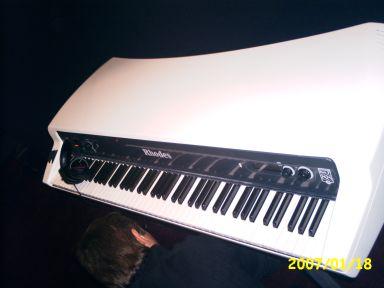
(also see the Rhodes Mark 7 NAMM 2008 Product Release post for the latest information)
UPDATE: It seems that popular enthusiast sites, including www.fenderrhodes.com, are being pressured into deleting all information critical of the new Rhodes Mark 7. And even stranger, any critical remarks regarding the new Rhodes Music Corporation website are being pulled as well.
I’ve written about many of the deleted posts here on my site:
Fender Rhodes Super Site bowing down to the new Rhodes Music Corporation
Rhodes Mark 7 endorsement from Jeff Lorber?
The weight of the Rhodes Mark 7 electric piano
Mark V action technology mysteriously vanishes from the Rhodes Mark 7
Rhodes Music Corporation benefiting from vintage Rhodes forum
Sorry for that interruption. On with my first impressions of the Rhodes Mark 7:
Let me start, first, by saying that I have not seen one of these in person. However, from the following pictures it is possible to make some distinct observations. Overall, the Rhodes Mark 7 piano shown at NAMM looks a little rough. Almost as though it was thrown together: a frankenstein of modern electronics and the guts from vintage (70’s/80’s) Rhodes pianos.
And I mean that literally. The guts of these things could come only from old Rhodes pianos. Given the production facilities the original Rhodes pianos demanded, I find it impossible to believe that the electromechanical parts in the Mark 7 come from a source other than old Rhodes pianos or New-Old-Stock (NOS) parts.
However, recently a person at Major Key built the Major Key 54. A Rhodes that is comprised of “65% new parts, 30% new/old stock [leftover from when the factory closed], and 5% whatever [i.e., the Harmonic Clarifier]”. This, perhaps, shows that the Mark 7 could be built without using parts from old Rhodes pianos. Perhaps the Mark 7, like the Major Key 54, used only new parts, NOS parts, and new electronics (MIDI/USB/PRE).
But wait! Making that scenario even less likely is the fact that the new Rhodes corporation claims the Mark 7 is based off of Mark V technology. For those unaware, the Mark V included some significant differences from previous models. Most notable was the increased hammer throw, resulting in a more expressive piano. You can read about the Mark V at the Fender Rhodes Super Site.
Possibly because there were relatively few Mark V pianos made (estimates range between 2,000-4,000), many Mark V owners find it difficult, if not impossible, to acquire replacement parts. Specifically, the plastic hammer assemblies in the Mark V are unique to that model. Some claim that the increased hammer throw causes long-term fatigue in the hammer arm pin area, ultimately resulting in the failure of that part. Stories of Mark V owners with this problem say that they have had to find creative solutions, because the only known source for this particular replacement part is other, used, Mark V pianos. As Mark V pianos can sell for $5,000 on on-line auctions sites such as eBay, buying a Mark V for spare parts can be economically unfeasible.
Why all of this history? Because I believe that unless the new Rhodes corporation bought a number of Mark V pianos, to use for supplying the guts of the Mark 7, then the pianos they demoed at NAMM could not have contained “Mark 5 action design”, as they claim on their website.
So, let’s assume that the models at NAMM did have the Mark V action design and in order to achieve that, they cannibalized a number of Mark V pianos.
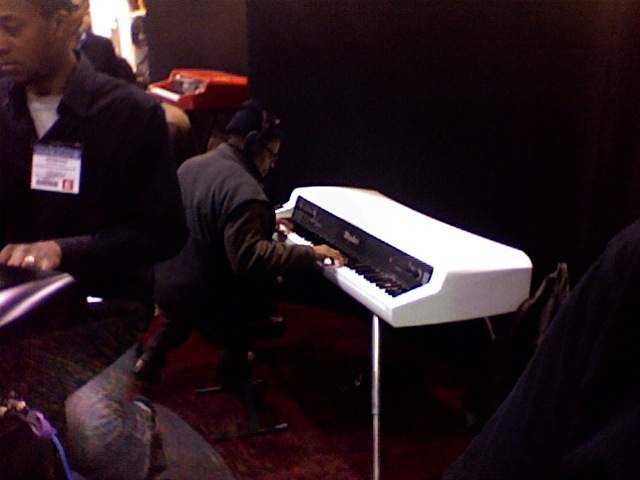
Well, if you look closely in the pictures from NAMM, they show a 88-key version of the Mark 7 (it’s the white one). Now, I think that I may have used the word “frankenstein” too soon. In fact, I should have saved it to describe what I think about the 88-key Mark 7 they unveiled at NAMM. If the new Rhodes corporation had used vintage Mark V pianos to supply the guts of their Mark 7’s, they would have had some unique challenges while constructing their 88-key model. This is because the Mark V only came in a 73-key model.
I can imagine that they took parts from an 88-key Mark I and Mark II, and combined them with parts from 2 Mark V’s to create this beast. That’s a thought!
For now, let’s forget the gruesome method they employed in creating these monsters, and focus more on the product that they ended up with: the Rhodes Mark 7.
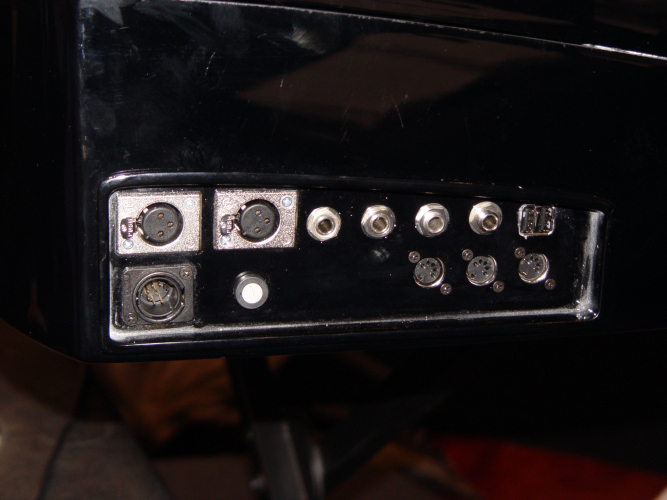
Here is another picture of the Mark 7. Let’s see what we can find. Looks like we can see the “Ventilated humidity system”, which looks like some speaker slits in the top of the case, and of course the I/O panel is visible. Not sure why they thought they needed a moisture vent. The vintage Rhodes pianos do not have them, and they have been working fine for over 20 years.
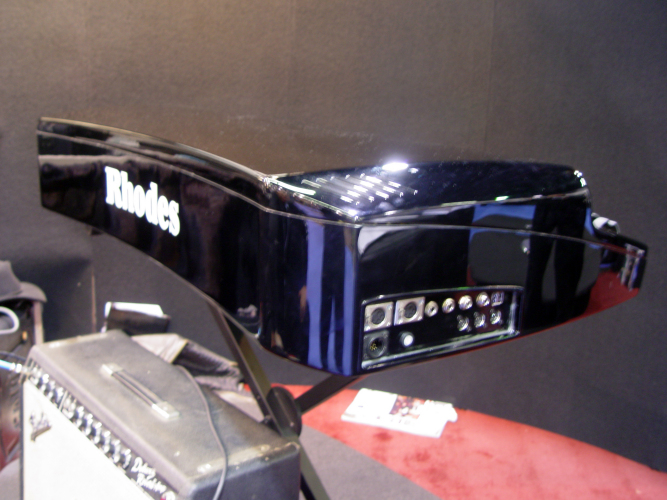
And now, let’s take a look at the quality (or lack thereof) of the I/O panel. Hmmm. Aside from the lack of labeling, crooked XLR inputs, and MIDI jacks that aren’t properly aligned (the number 3 MIDI pin should be at the top, as is standard procedure in all other MIDI equipment), it doesn’t look /that/ bad. It should be nice to have those available. However, take a look at the scratching on the gloss finish. Looks like a Mark 7 wouldn’t look nice for long if you gigged with it. Also, what’s with the dust around the edges of the panel?
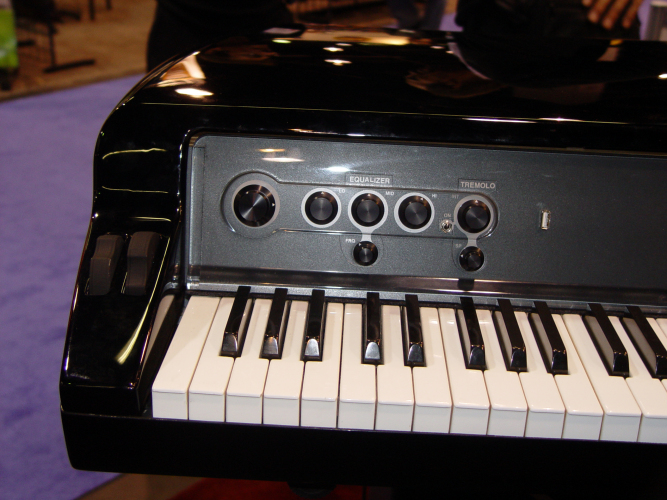
Next, we see the font panel. Some rhodes owners have commented that the controls are not very well defined, and that the layout could improve. The first thing I noticed in this picture was the interior wooden harp showing at the top left between the front panel and the lid of the instrument. These pianos don’t seem to be very refined. Are they /hoping/ to make these in quantity with any amount of quality, or are they just showing what they can assemble in their garage over the weekend?
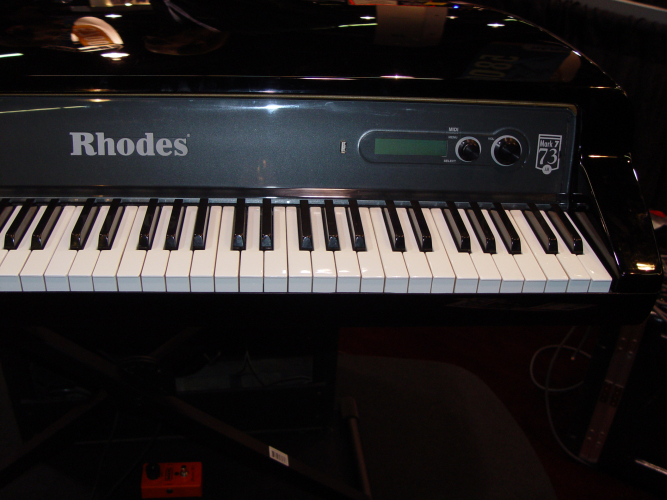
Finally we see the other half of the front panel. Obviously, the keys at the right end are not level, and any number of things can cause this. Again, strange for that problem to be apparent on a floor model for the piano’s introduction to the world. And in this picture, and the last, I almost missed something. It was pointed out to me in an on-line forum, and I hadn’t seen it, I think, because it’s the last place I would want them to be. On the front panel there are 2 USB ports, clumsily located on each end. I can’t think of an argument for that placement. They almost seem to be in the way there. Finally, the wooden harp can be seen between the gap in the front panel and the lid running the length of the piano.
In conclusion, given that a vintage Rhodes piano can be purchased under $1,000US, I’m not sure how they are going to sell these for a profit. The additional electronics can be added to a vintage Rhodes: $200 for a preamp and $1,000 for a MIDI strip installed (in fact you can install the same optical MIDI strip used in the Mark 7, if you want). It seems like the Mark 7 will sell if it is priced under $2500 with MIDI and preamp. Pricing should be available in February from the new Rhodes corporation.
Ok…..getting my first look at the Rhodes Mark 7 electromechanical piano, and boy! I’m not sure what to think yet. I need to see more pictures….inside and out! I’m sure more will come.
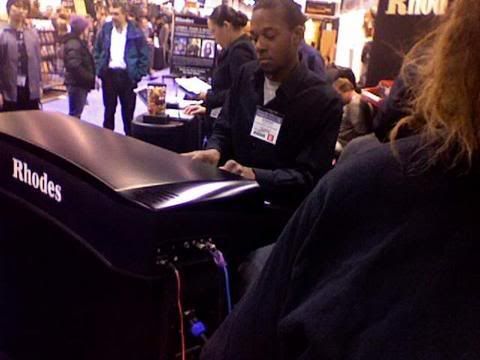
You can keep up-to-date on it by visiting The Super Site forum:
Wow. Well tomorrow at NAMM, I hear that the Rhodes Mark 7 piano will be released. Apparently, as many die-hard Rhodes fans had hoped, the Mark 7 will be a true electromechanical piano. From what I have read, it will have the “guts” of the Mark V; the previous model last built in 1984. One side note: as a Mark V owner this excites me knowing that I may be able to buy new parts for my aging piano!
The Mark 7 will come in 3 sizes, 88/73/61 keys, each with 3 “trim” levels: passive electronics (like the original Rhodes), active electronics (on-board powered preamp), and MIDI with active electronics.
I’m not sure what the pricing will be, or what they look like. But by February this information should be readily available!
Wow. So I just found a great owner’s manual site from Yamaha. I searched for ‘CP-80’ and easily found the owner’s manual for my Yamaha CP-80.
http://www.yamaha.co.jp/manual/english/index.php
Go get ’em!